
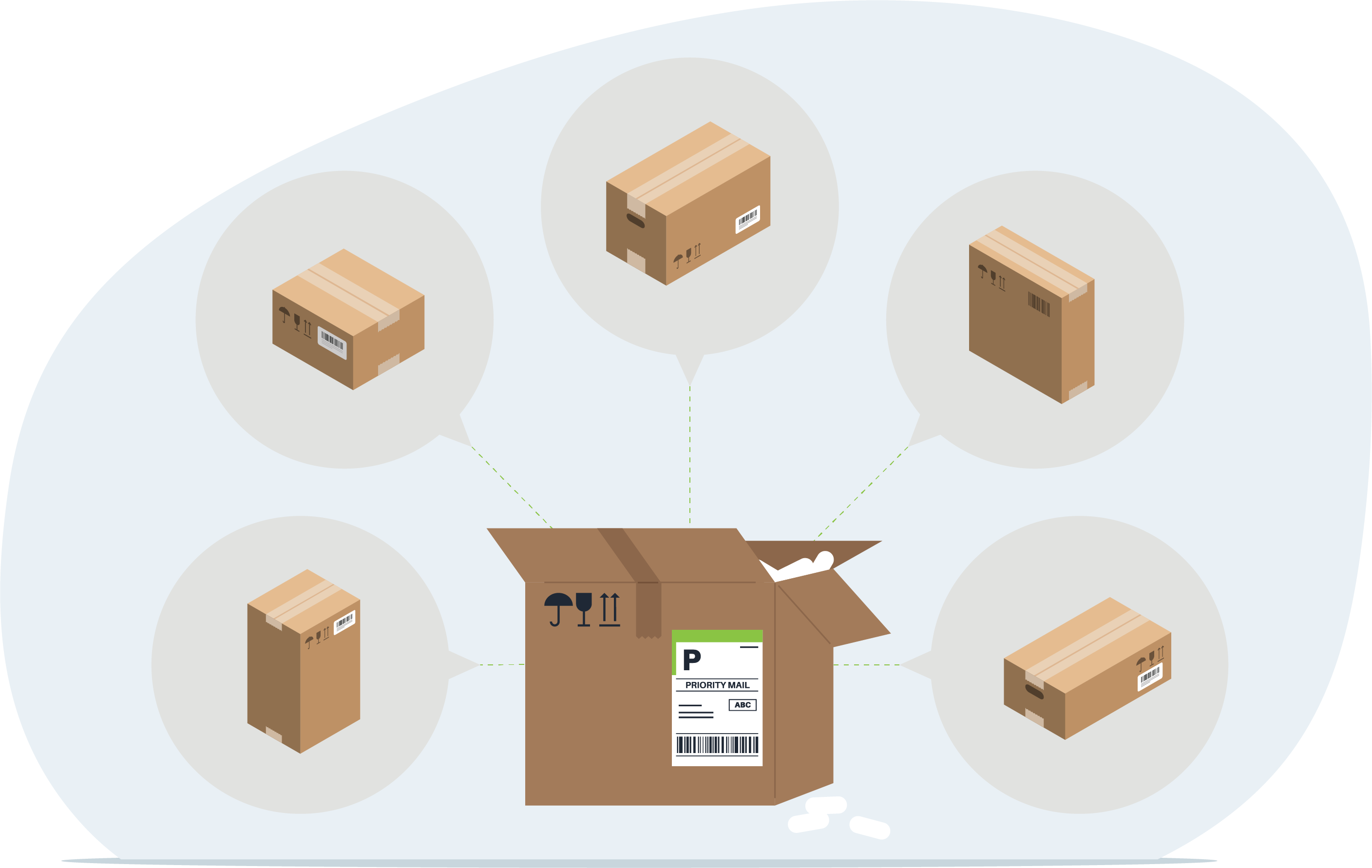
In today’s shipping landscape, volume matters more than weight. As carriers increasingly base charges on dimensional (volumetric) weight over the actual weight of a shipment (actually, whichever is higher…), accurate package calculations has become critical. Businesses that fail to optimize their packing strategies risk overpaying for freight, undercharging customers at checkout, or both.
2Ship’s Item2Box algorithm addresses this challenge by automating the packing decision process, ensuring every order is packed efficiently and rated accurately. This white paper explores the technology, logic, and real-world impact of Item2Box for businesses handling e-commerce, B2B, or omnichannel shipping.
The Challenge: Packing for Accuracy and Cost Control
Most shipping solutions calculate rates based on total order weight, often assuming a single package. This oversimplification works only in small-scale scenarios. When orders include multiple items or bulky products, the variance between estimated and actual shipping cost can be significant.
Key issues with traditional methods:
- Inaccurate real-time rates at checkout
- Underestimated freight costs
- Manual intervention required in the warehouse
- Additional equipment needed (scales, dimension scanners)
- Poor customer experience due to incorrect shipping quotes
The 2Ship Solution: Item2Box Algorithm
Item2Box is an advanced packing algorithm built into the 2Ship Transport Management System (TMS). It determines the most efficient way to pack an order using your existing box inventory. It does so by calculating:
- The number of packages required
- The best-fitting box sizes based on the available stock
- The weight and dimensions of each packed box
Core Inputs:
- Product Information
- Dimensions and weight of each item as packed individually
- Optional: stacking, orientation constraints
- Box Inventory (Package Table)
- Internal dimensions
- Wall thickness
- Padding allowance (e.g., for void fill or cushioning)
- Maximum allowable weight
- Business Rules
- Preferred packing methods
- Restrictions on item grouping
- Fulfillment center capabilities
How It Works: Step-by-Step
- Data Setup Businesses define all SKUs with dimensional and weight attributes. Box sizes are entered into the Package Table with all necessary parameters.
- Order Received When a customer places an order, 2Ship accesses the dimensional data for each item.
- Box Fit Evaluation Item2Box evaluates all available box configurations to determine:
- How to pack items using the smallest number of boxes
- Which boxes provide the tightest fit without exceeding volume or weight thresholds
- Packaging Recommendation The algorithm produces an exact breakdown of:
- Which items and quantities go into which box
- The dimensions and weight of each box
- Real-Time Rating With exact package information, 2Ship runs multi-carrier rating, identifying the lowest-cost and best-performing services available, all before the order reaches the warehouse.
- Warehouse Execution Warehouse staff receive packing instructions aligned with the algorithm’s recommendations. No need for weighing or measuring: follow the guide and pack with confidence.
Advantages of Using Item2Box
- Shipping Cost Optimization: Use the smallest possible box volume, reducing dimensional weight charges
- Accurate Checkout Rates: Provide precise quotes to customers based on true package data
- Reduced Hardware Costs: Eliminate the need for scales and dimension scanners in the warehouse
- Increased Fulfillment Speed: Predefined packing plans reduce handling and decision time
- Minimized Human Error: System-calculated packing removes guesswork and inconsistencies
- Carrier Compliance: Ensures packages comply with carrier limits and packing standards
Real-World Impact
Companies using Item2Box have reported:
- Up to 30% savings in freight costs through reduced dimensional charges
- Drastic reduction in chargebacks from carriers due to dimension mismatches
- Faster warehouse throughput and fewer packing errors
- Improved customer satisfaction with accurate shipping costs
Conclusion
The logistics of order fulfillment is no longer just about getting items into boxes, it’s about how well you calculate what goes into which box. With 2Ship’s Item2Box, businesses gain a strategic edge by leveraging automation to reduce shipping costs, improve accuracy, and streamline operations.
By embedding Item2Box into your shipping workflow, you’re not just packing smarter… you’re shipping smarter.
Ready to optimize your shipping strategy? Get in touch with 2Ship today to learn how Item2Box can transform your fulfillment process.